

Particula and KPK Partner to Bring Risk Ratings to Tokenized Asset Allocation

Tokenized instruments are increasingly evaluated using frameworks designed for a different class of asset entirely. A risk team assessing a tokenized bond or fund exposure may reasonably apply the same credit lens used for its traditional counterpart — until that analysis reaches a smart contract, a redemption mechanism, or a custodial arrangement that a conventional framework was never designed to assess.
KPK, a leading curator for vaults and other on-chain investment products, has added Particula as a risk assessment partner to help close that gap. This piece looks at what changes when an asset is tokenized, how Particula's methodology accounts for it, and where that assessment fits into how KPK decides what belongs in its vaults.
Tokenization doesn't just wrap an asset, it restructures it
Most risk methodologies built for traditional markets treat the blockchain as plumbing — a settlement layer sitting underneath an otherwise familiar instrument. That assumption doesn't hold up well in practice. Once smart contract logic, on-chain governance, and programmable transaction rules govern how an instrument actually functions, they stop being implementation details and become part of the instrument's risk profile.
That's the gap Particula's methodology is built to close. The Particula Digital Asset Risk Framework (PDARF) addresses this through a rules-based, quantitative methodology designed to assess the risk profile of asset-backed tokens using observable data inputs and standardized assessment criteria. The framework provides institutional market participants with transparent, structured risk assessments that evaluate token design integrity, legal enforceability, regulatory coverage, reserve adequacy, and operational resilience.
What PDARF actually measures
The depth of the framework is where it earns its keep. PDARF scores tokens across 129 individual risk attributes, organized into thematic groups and rolled up into three pillars:
Counterparty Risk - the issuer's regulatory standing, financial resilience, and operational and compliance frameworks. An asset can only be as reliable as the entity standing behind it.
Structural Risk - token implementation design, investor protection mechanisms, issuance structure, token economics, and the blockchain ecosystem the token depends on. This is where smart contract risk, redemption mechanics, and bankruptcy remoteness live.
Underlying Asset Risk - the credit quality of what backs the token and the reliability of the custodial arrangements protecting it.
Ratings run on an AAA to D scale, with rating caps built in for specific failure modes: inadequate licensing, missing bankruptcy remoteness, contractual (rather than direct) claims on underlying assets, absent reserve verification, or low-quality collateral. A token can't average its way past a fundamental structural gap.
In parallel with the Risk Rating Score, the PDARF framework calculates a Data Confidence Score that measures the completeness and reliability of available information across 199 data points, including the 129 risk-relevant attributes. Higher Confidence Scores indicate greater confidence in the underlying data supporting the risk rating. Lower scores may signal disclosure gaps, inconsistencies, or reliance on incomplete information, which users should consider when interpreting risk ratings.
"Tokenized assets sometimes don't fail the way DeFi-native assets do, the risk usually sits in the issuer, the legal structure, or how redemption actually works in practice, not just in market pricing," said Timm Reinsdorf, Managing Director of Particula. "Our job is to turn that into something KPK's risk committee can act on: a consistent framework, verified documentation, a risk rating, and a monitoring feed that updates with any change."
The role of independent assessment in KPK's due diligence
KPK's own due diligence sets the ceiling on what a vault can lend into, long before anything goes live. Bringing an independent, quantitative risk framework into that process adds a check that doesn't share KPK's own incentives: a rules-based assessment, built on observable data rather than case-by-case judgment, that produces the same kind of structured output regardless of which asset it's looking at.
That consistency is the point. An ordinal scale only means something if every instrument on it was measured the same way. PDARF's hierarchical structure: attribute, attribute group and pillar exists so that a rating can be compared across very different token types.
KPK's judgment continues to decide what gets listed and at what size. Where a Particula assessment exists, it becomes part of the evidence that judgment is built on a second, independently derived read on an asset that KPK's own review can be measured against.
“Each asset, market, strategy or counterparty undergoes a structured review under KPK's Due Diligence Framework, covering more than 150 checks across 12 risk dimensions. Particula's ratings addition is a step further in making our analyses stronger and independent." Giel Detienne - Head of Curation
*Disclaimer
Particula maintains full independence in its assessment processes. This partnership pertains exclusively to technical and operational infrastructure integration and does not influence Particula's analytical independence, methodologies, assessment criteria, or risk rating determinations. All instruments assessed in connection with KPK's infrastructure and process are subject to Particula's standard rules-based assessment criteria and methodologies, applied consistently without modification, preferential treatment, or commercial consideration. Particula maintains internal policies to identify, manage, and disclose actual and potential conflicts of interest in accordance with industry best practices.
About Particula
Particula is the prime rating provider for digital assets, transforming on- and off-chain data into actionable insights. The company delivers next-generation risk ratings and comprehensive analyses, across issuer and counterparties, issuance structure, technical implementation and underlying risk – providing the clarity and confidence needed to navigate the complexities of digital finance.
About KPK
KPK is a non-custodial onchain asset manager for DAOs, institutions and capital allocators, actively managing capital across DeFi since 2020. Over $8bn deployed onchain, more than 16,000 transactions and zero funds lost. For more information visit kpk.io.

Latest News & Insights

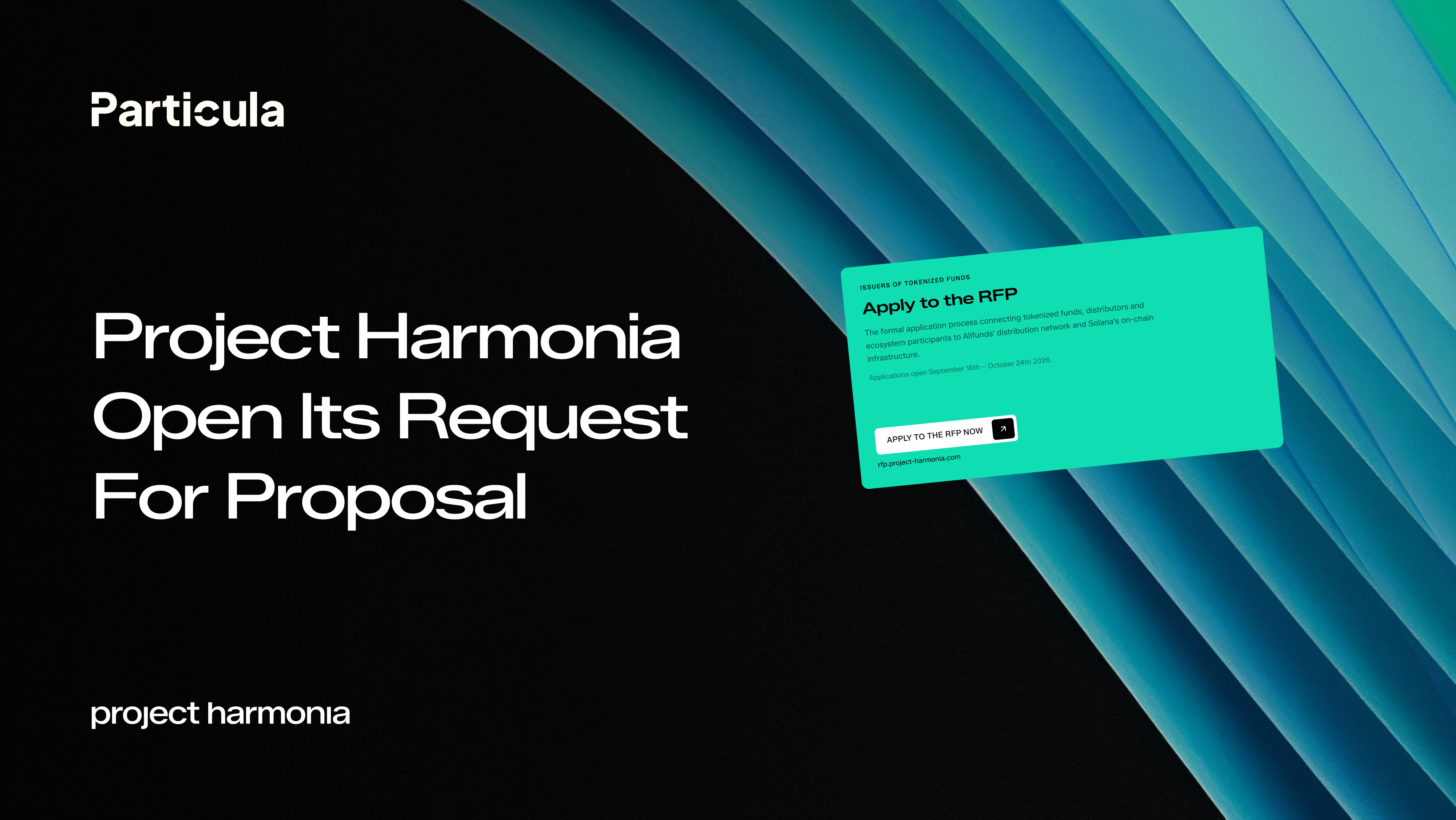
Project Harmonia opens for applications: the RFP is live
Today, September 17, 2026, Project Harmonia opens its Request for Proposals. Issuers, distributors and ecosystem participants can now register and apply for admission to a program connecting Allfunds' institutional distribution network with Solana's on-chain infrastructure.
.png)